
Inside AIAP: The Apprenticeship That Built Singapore’s AI Engineering Team
 Preview image loads from YouTube (Google). The video itself loads only when you press play.
I was updating the aifirstnation.org website recently and rewatched the short film Google Cloud made about us in June 2023, “AI Singapore is solving for the next generation of AI and local talent”. The camera spends most of its time inside the AI Apprenticeship Programme (AIAP), watching passionate individuals with no AI background turn into industry-ready AI engineers.
It is a good film, and I am grateful for it. But a film shows the workshop; it cannot show the reasoning. Updating the site seemed like a good prompt to finally write that reasoning down.
Why we did not build a course
When AI Singapore started in 2017, the obvious move was to fund courses. Everyone else was funding courses. We did not, and the reason is simple: AI training that treats everyone the same does not stick. An engineer who has never shipped software cannot become an AI engineer by watching someone else talk about models.
AI engineering is a craft. Crafts are learned by apprenticeship: by doing real work, on real problems, under people who have done it before, with consequences when it does not work. So in 2018 we built the AIAP as a proper apprenticeship: full-time, paid, selective about aptitude rather than pedigree, and built around real industry projects from day one.
What the model actually is
The programme today runs nine months, in two phases: three months of deep skilling, then six months of project work.
When we started, the split was two months and seven. We changed it, for two reasons. First, there is simply more to deep skill now: the tooling, the engineering practices, and the field itself have all grown, and cutting skilling short meant apprentices learned it badly on the job. Second, generative AI lets a well-trained team ship production code much faster than it could in 2018, so the project phase no longer needs seven months to get the same outcome. We rebalanced toward more foundation and faster delivery.
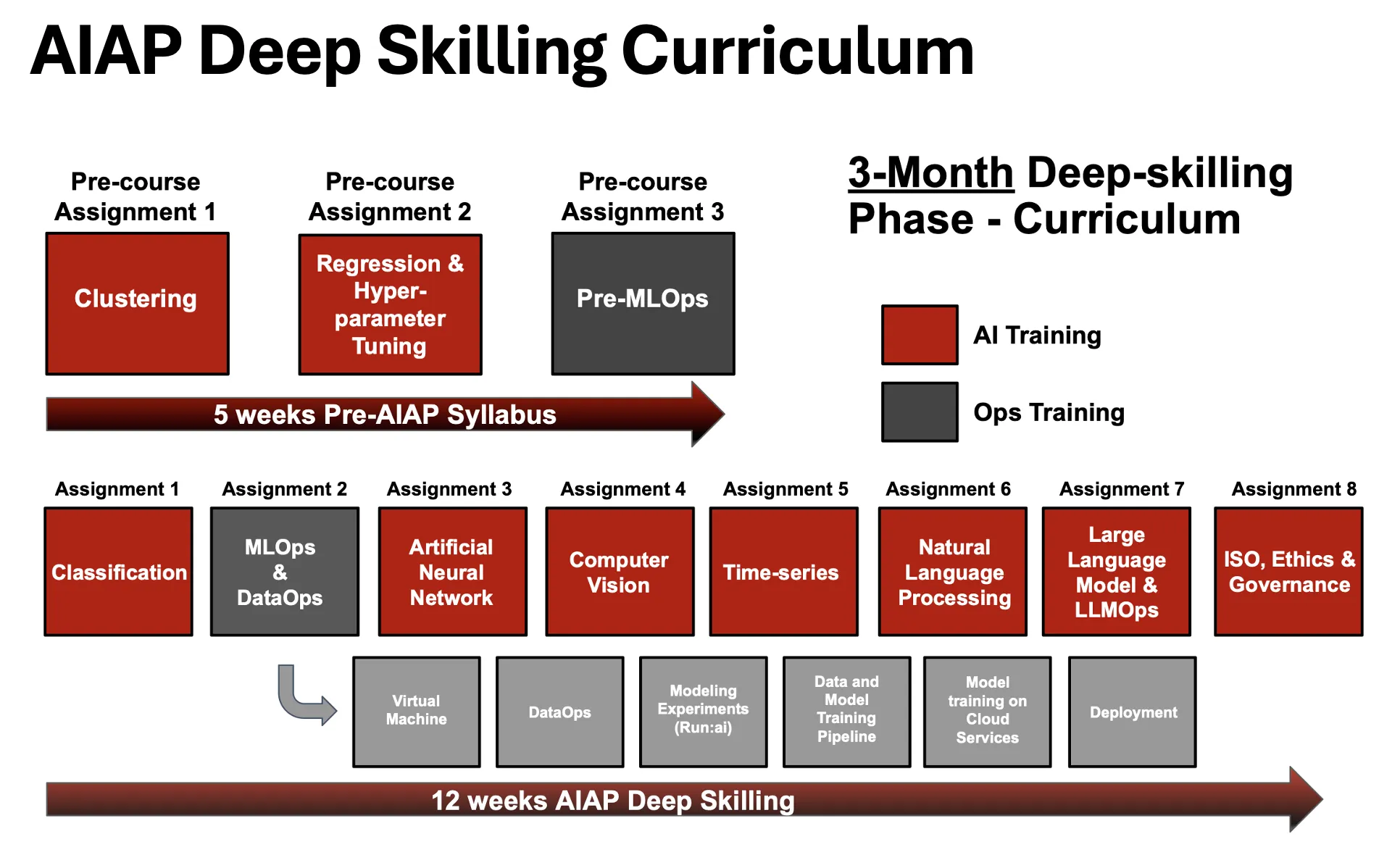
The deep-skilling phase is a shock on purpose. Most apprentices arrive having self-taught machine learning algorithms. Almost none arrive with Docker, Git, testing, or the software engineering habits that decide whether a model ever reaches production. There are no classrooms and no lectures; there are self-directed assignments, code reviews, and mentors who keep raising the bar. The curriculum changes whenever the technology does. The current map is below: a five-week pre-course before apprentices arrive, then twelve weeks of assignments that pair AI training, from classification to LLMs and LLMOps, with ops training on VMs, pipelines, cloud services, and deployment.
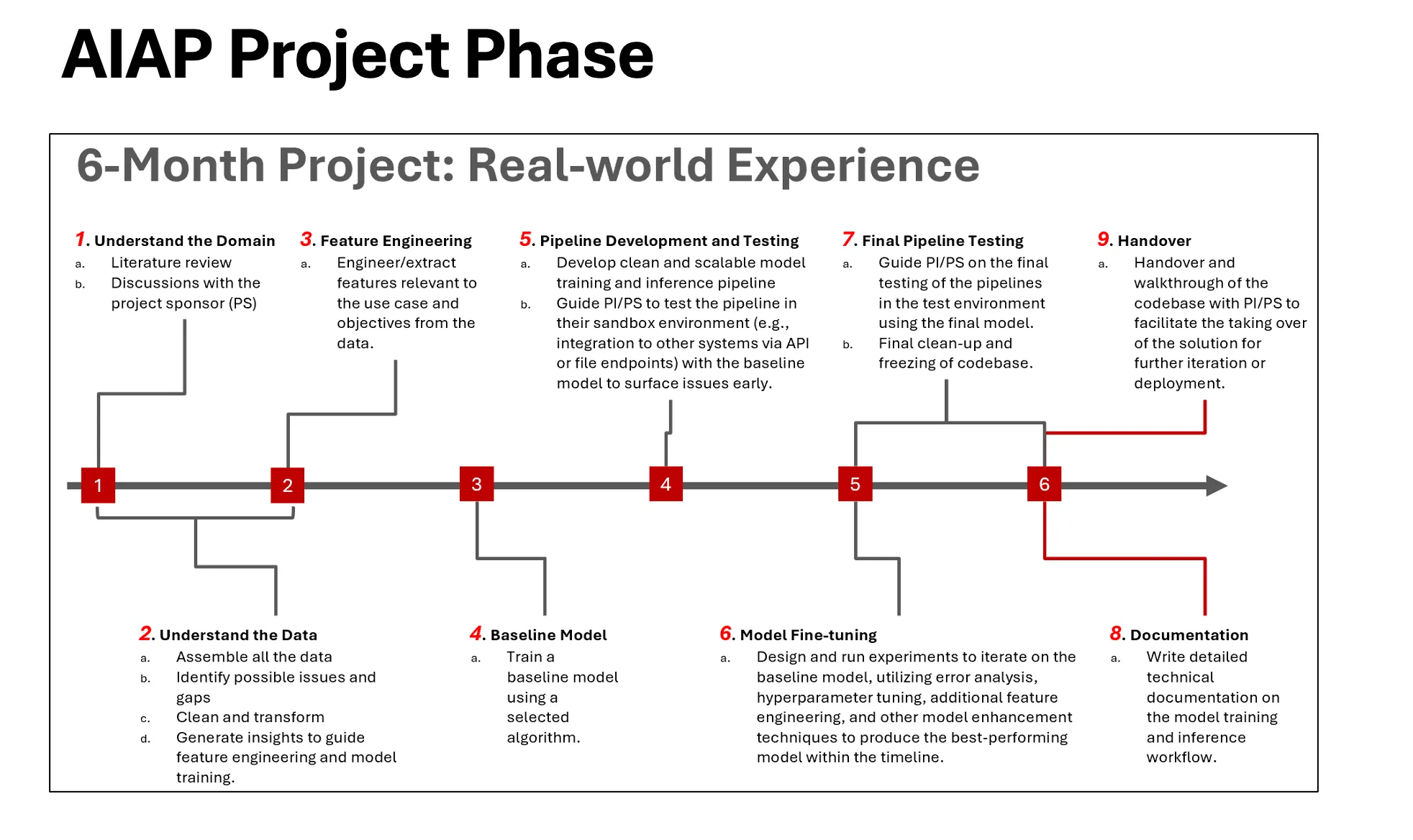
The project phase is the real thing: apprentices join 100 Experiments (100E) project teams and build AI solutions for companies that have co-invested real money to solve business problems they actually have. A team is a full-time AI engineer as mentor, four to six apprentices, and a professional project manager, working together at AI Singapore through every stage from data cleaning to deployment. Nobody learns AI engineering by interning alone in a corner of someone else’s office. They learn it the way the film shows: as a team, shipping.
The six months run as seven four-week sprints against ten milestone gates, from M1 to M10, and every gate expects artifacts: reports and presentations, scripts and code, demos, deployed solutions.
We have also since introduced a shorter variant, AIAP for Industry, to target a different profile of apprentices. It keeps the same three months of deep skilling and shortens the project phase to three months, a 3+3 design.
What the video captures that matters
Watch the film for two things: the people, and the technology.
The first is the variety of people. We have always hired for aptitude, not résumés: no AI degree required, no prior AI career required. When we analysed four cohorts of applicants, the successful candidates shared three traits: they had shipped something real, they had trained intensively and finished what they started, and they were at a career stage where a structured programme made sense. Everything else (schools, certificates, enthusiasm) was secondary. That is why a blue-ocean hiring strategy worked: the talent was always there; the industry was just looking in the wrong pond.
The second is the technology. The apprentices in the film build on Google Cloud, and Google is a valued platform partner. That is not a stack choice. AIAP is cloud agnostic: apprentices build on the stack the project sponsor already runs. In practice that means we partner with the major platform providers (Google, Microsoft, AWS, Alibaba Cloud, Tencent, and others), because the sponsor’s stack and technology preferences drive selection, not ours. An AIAP team is as comfortable on Azure as on GCP, because the point of the apprenticeship is engineering craft that transfers, not loyalty to one vendor’s console.
The scoreboard
At the time the film was made, in mid-2023, the programme had trained over 300 Singaporeans. Today the number is more than 500 AI engineers. These are Singaporeans who learned the craft on company problem statements and now anchor AI teams across the public service, banks, insurers, manufacturers, and startups. Companies do not hire AIAP graduates as a favour. They hire them because they arrive having already deployed AI in production, several times, with stakeholders watching.
LearnAI, our programme for every Singaporean, has AI-enabled more than 350,000 people. AIAP is the top of that ladder, and nobody reaches it in one step. The route runs AI For Everyone (AI4E), then AI For Industry (AI4I), then AIAP Foundations, and finally AIAP. For someone starting with no programming and no AI background, the path typically takes twelve to eighteen months of steady work before they are ready for the apprenticeship. That is what a real pathway looks like: long enough to change what someone can do.
If you are an organisation watching this
The transferable idea is the principle underneath: people learn AI by shipping AI on problems that matter, in teams, with mentorship and consequences. Whatever you build (an internal apprenticeship, a guild, a partnership with a programme like AIAP), hold to that principle and refuse the course-catalogue version. That is the difference between training that decorates a résumé and training that changes what an individual can do. And for the organisation, it is the difference between staff who have attended AI courses and teams that can put AI into production.
The full playbook (AIAP, 100E, LearnAI, AIRI, and how the pieces fit a nation) is in the book. If you are wondering whether you could get in, read what successful AIAP candidates actually look like.
- careers
- policy