
SME AI Starter Kit

SME AI Starter Kit: From First Idea to First Project
Two weeks ago I published why I launched ai4sme.org: nine years of national AI programmes distilled into one free website with no queue. That essay made the case; it did not carry the instructions. This one does. The order to use the site in, what each step gives you, and where the SME AI Starter Kit fits.
One change since the launch essay. The download I called the SME AI Deployment Guide is now the SME AI Starter Kit: one printable kit in four parts, still free. If you read only one page of the site, make it the kit page, and also do the AI readiness assessment, so start there.
Start with the measurement
Go to ai4sme.org/assess. The assessment is free, needs no account, and runs on the site's dedicated instance on AIRI Hub, the assessment platform for the AI Readiness Index. I created the index in 2019, and across the programmes we have assessed more than five thousand organisations with it.
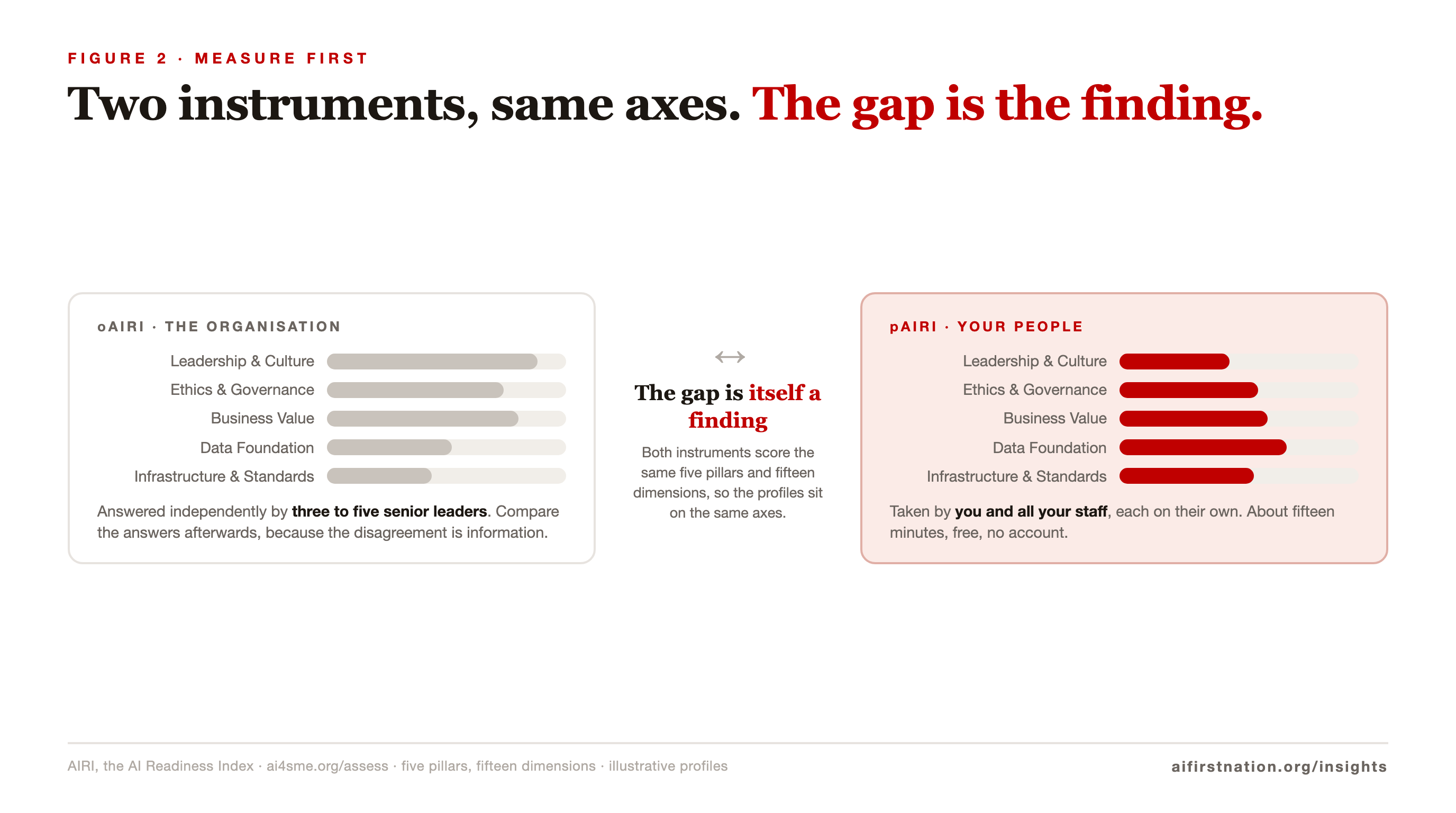
There are two instruments, about fifteen minutes each. The organisational one, oAIRI, is answered independently by three to five senior leaders, and you compare the answers afterwards, because the disagreement is information. The personal one, pAIRI, is taken by you and all your staff, each on their own. Both score the same five pillars and fifteen dimensions, so the two profiles sit on the same axes, and the gap between them is itself a finding. When your people are ready and your organisation is not, the leadership needs to step up. When leadership is ready and the workforce is not, no AI initiative will succeed.
The emailed report shows where you are in your AI readiness, from AI Unaware to AI Catalyst, and includes six AI use cases already running in your industry. For most SMEs the destination is AI Ready, Level 2: simple department-level workflows your own people run. The framework is explicit that Level 2 is the success target, not a consolation prize. And of the five pillars of the AI readiness assessment, only two are technical. Readiness is a leadership matter before it is an IT project.
Nobody starts from a blank page
Your report lists six AI use cases. The library carries all 308 (and I will continue to add more), across 25 industries, and the directory is open to browse: 12 to 14 cases per industry, each tagged with its effort band (quick win, medium term, transformational). Each case is a plain summary of what the use case is, how it works, the impact you can expect, the tools involved and the roles it touches, and most carry links to public sources if you want the fuller story.
Start with the quick wins, the cases that run in days to weeks on AI subscriptions you can cancel monthly. A retailer drafts product descriptions from its own catalogue data and cuts writing time by seventy to eighty per cent; one went from two-day listings to same-day. A construction firm drafts meeting minutes and site reports from the briefing recording, with documentation time down sixty to seventy per cent. A service business answers customer enquiries around the clock from its own FAQ and tracking page, and a quarter to two-fifths of routine queries stop reaching staff: two to three hours back per person per day. No project, no consultant, no new hire required.
The medium-term band needs data plumbing and integration, and typically takes 3-6 months. The transformational band restructures how the business works, over years, and the library is blunt about it: not a first project. Get one workflow running before you touch the transformational band.
Start learning
What if you have no idea what AI is? The course is at ai4sme.org/learn: 14 lessons, about three hours. No login, no fees, no grants to apply, and every lesson ends with one thing to try on your own business. For staff who need a gentler on-ramp, the free course at hokkien.me explains AI over a plate of Hokkien Mee.
The starter kit, page by page
Now the download: ai4sme.org/kit. The kit is free under CC BY 4.0, so print it and run your management meeting off it. Print it properly. The pages are meant to be written on.
Part one is the idea hunt. Two brainstorm prompts for you and your team, with one rule: list without filtering. A pen-ready grid takes up to eight pain points, and a one-line template clusters the similar ones into one sharp problem statement. The idea hunt comes first on purpose. A scoring engine is useless without real problems to score, and the problems are usually already there, just never listed.
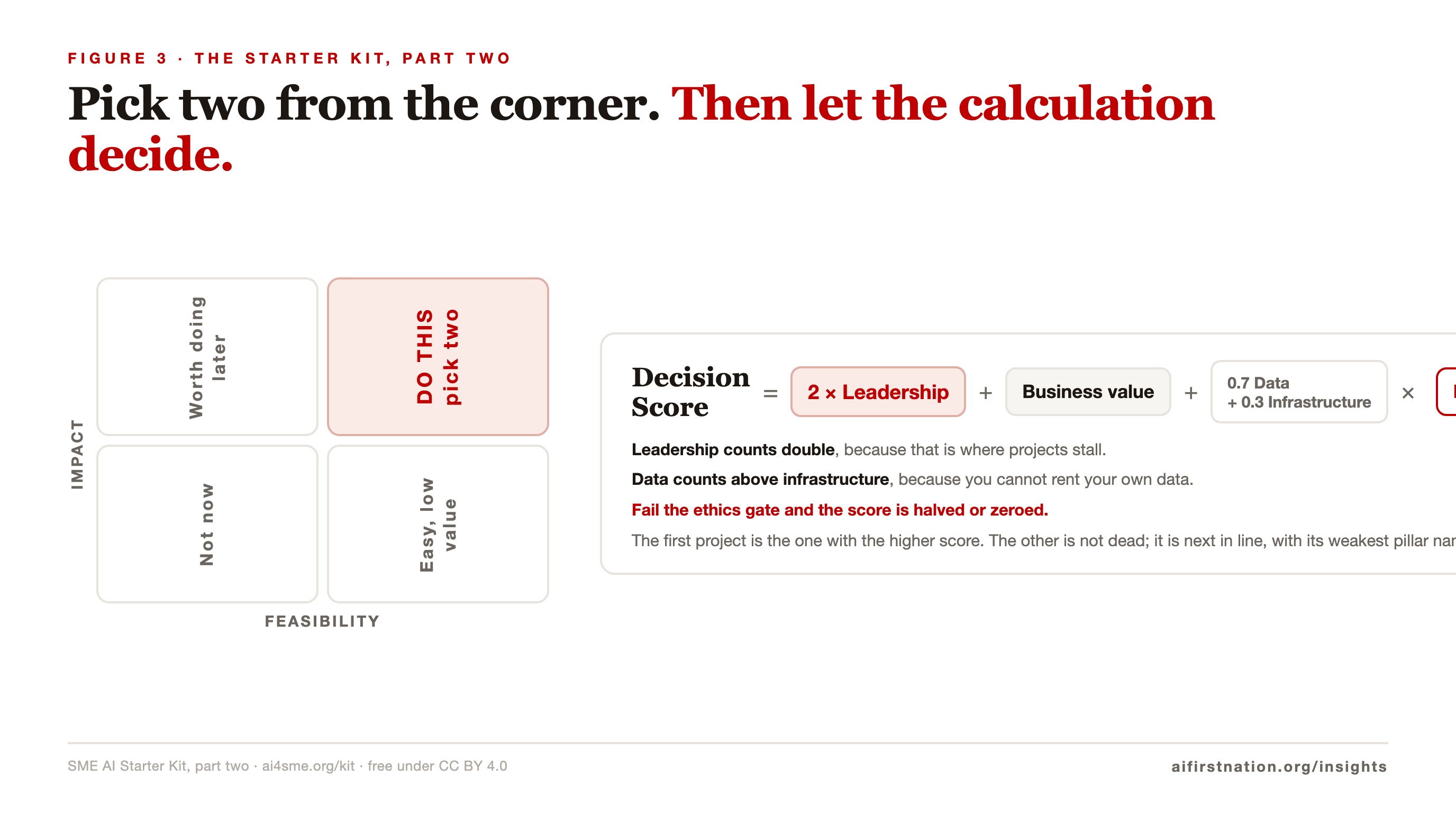
Part two is the 2x2 and the AIRI Decision Engine. Place each problem statement on a two-by-two of impact and feasibility, and pick two from the DO THIS corner. Then tick the level that fits on each of the five pillars, apply the ethics gate, and run the four-line calculation to a Decision Score. Leadership counts double, because that is where projects stall. Data counts above infrastructure, because you cannot rent your own data. Fail the ethics gate and the score is halved or zeroed. The first project is the one with the higher Decision Score. The project with the lower score is not dead; it is next in line, with its weakest pillar named, which tells you what to improve on.
Part three is build or buy. The buy path carries the eight questions to ask an AI provider before you sign anything. Three of them: does it run in production, with customers you can call about it, or only in demonstrations? Does it run in your systems? A (Jupyter) notebook handover does not count. And do the intellectual property, the data and the model weights become yours when the engagement ends? A provider that cannot answer these is selling you a model. The kit adds two actions to take before you sign. The build path is six steps, from problem statement to shipping and measuring, and the section closes with the adoption checklist: eight stages, a box for every check.
Part four is the progress tracker, the part that keeps the project honest. You fill it on day one, the day of your first assessment, and at every six-month review. It holds the readiness distribution of your people against the standard bar, six in ten at AI Ready; the spread of your leaders' scores; and the project register, where each project's Decision Score is written at inception and never changed, beside the revenue or savings it actually achieved. We only count real deployed projects in production. The model runs in your systems or it does not count, and a demonstration does not count.
Build, buy, or grow your own
The kit also walks the three ways an SME gets a workflow built. Subscribe and configure covers the quick wins. Grow your own sends a curious technical employee for mentored training: about one month of scoping and one month of part-time build on your own data, the intellectual property yours, and roughly seven in ten of these builds reach deployment. Build with help brings in a collaborator for the complex project, roughly six months, and you take the system over at the end.
The order is the method
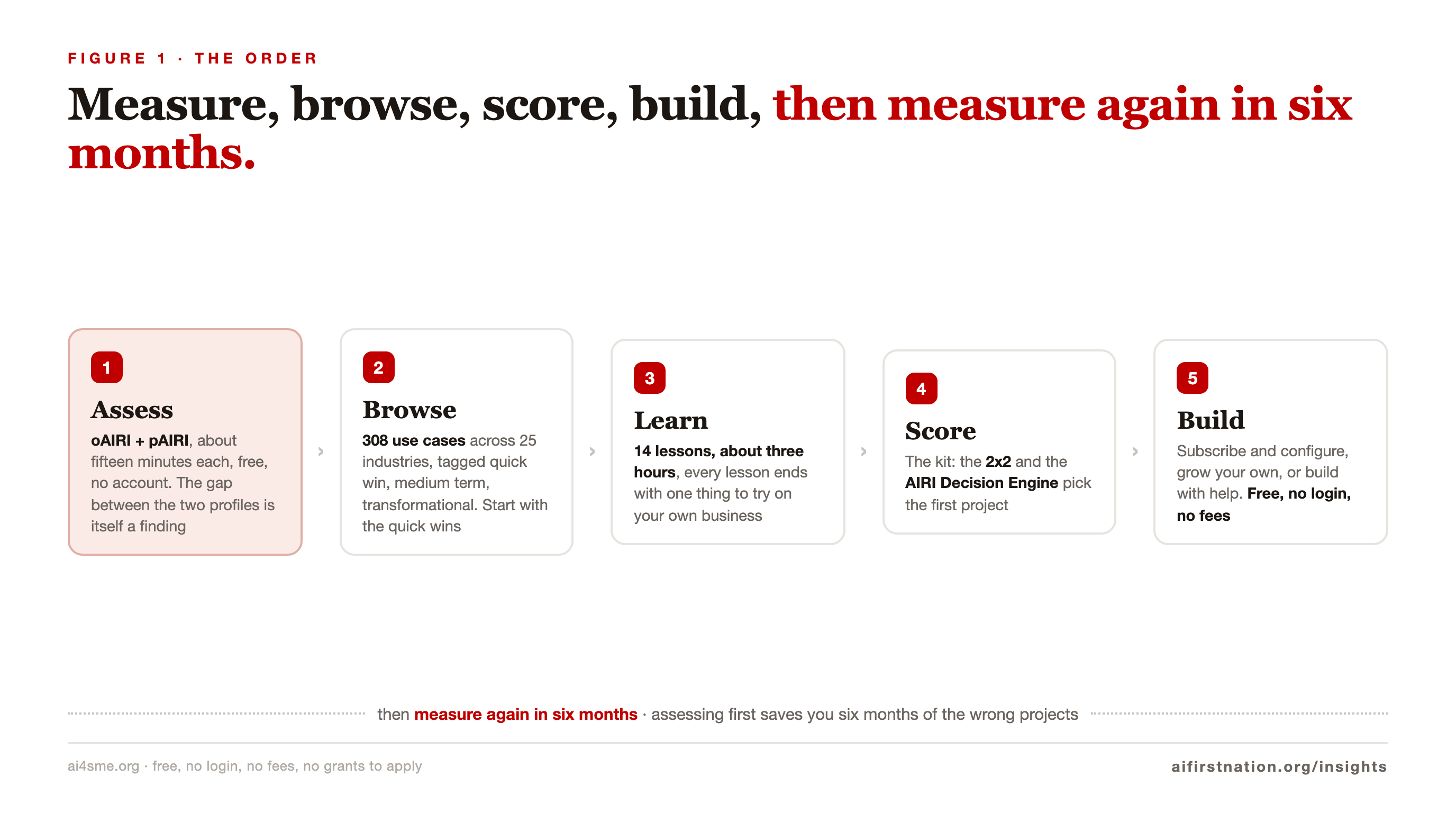
Measure, browse, score, build, then measure again in six months. An SME owner can decide on Friday and start on Monday, and nothing on the site asks for more commitment than that. Assessing first saves you six months of the wrong projects.
- AI4SME
- SME
- AIRI
- SME AI Starter Kit
- AI readiness
- AI adoption